
===================================================================================
                   NOTRE-DAME BASILICA: ARCHITECTURAL & SACRED MATRIX
===================================================================================
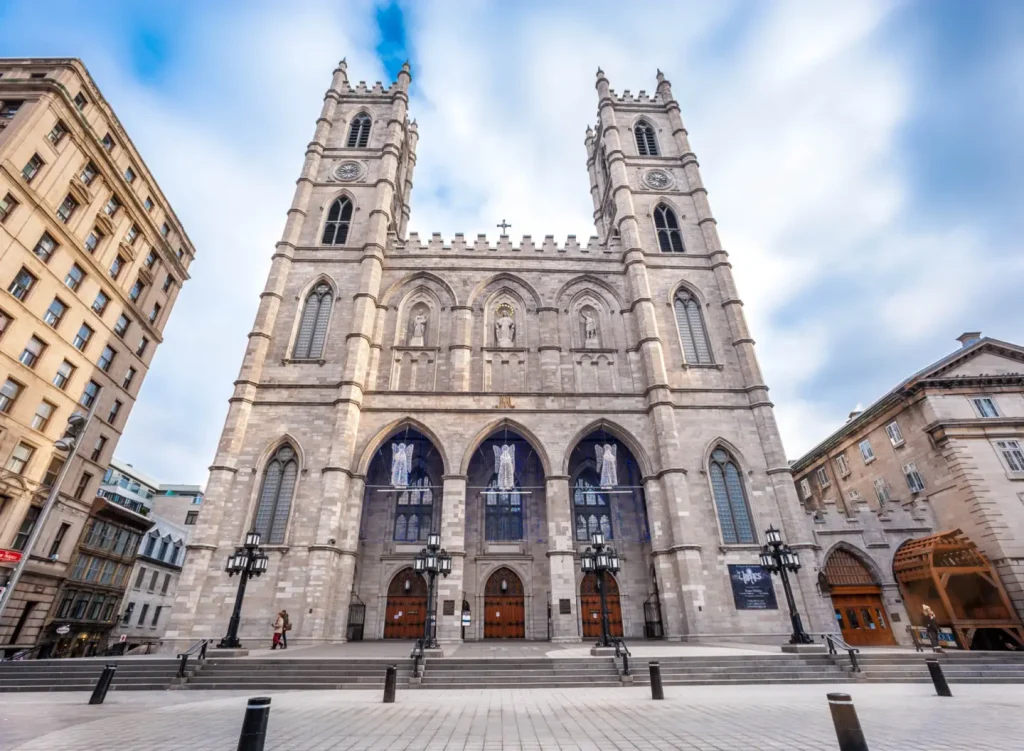
[ ARCHITECTURE ] ---------> Gothic Revival (James O'Donnell, 1824–1829)
[ ECCLESIASTICAL STATUS ] -> Minor Basilica (Decree by Pope John Paul II, 1982)
[ THEOLOGICAL ART ] ------> Polychromatic Sanctuary & Carved Black Walnut
[ ACOUSTIC HERITAGE ] ----> Casavant Frères Organ (Opus 238, 1891)
===================================================================================
In the realm of global ecclesiastical heritage, few sanctuaries embody the intersection of civic identity, theological symbolism, and architectural grandeur as powerfully as the Notre-Dame Basilica (Basilique Notre-Dame de Montréal). Situated in the historic sector of Old Montreal, Quebec, this sanctuary stands as a monumental testament to 19th-century religious devotion and the evolution of North American Catholic history.
As a prominent subject of religious news reporting, liturgical scholarship, and cultural preservation, Notre-Dame Basilica represents far more than a tourist destination—it functions as an active liturgical center, an archival repository of French-Canadian Catholic history, and a masterpiece of structural theology.
Historical Origins and the Sulpician Legacy
The structural evolution of Notre-Dame Basilica is deeply entwined with the Society of Saint-Sulpice (Sulpicians), an order of Catholic priests who assumed seigniorial ownership of the Island of Montreal in 1663. The original parish church, constructed between 1672 and 1683 under the direction of Superior François Dollier de Casson, served the growing colony of New France for over a century.
By the early 19th century, the rapid expansion of Montreal’s Catholic population rendered the 17th-century structure inadequate. In 1824, the parish wardens (fabrique) commissioned Irish-American Protestant architect James O’Donnell to design a new sanctuary capable of accommodating over 8,000 worshippers—making it the largest church in North America north of Mexico upon its completion.
+---------------------------------------------------------------------------------+
|                       CHRONOLOGICAL DEVELOPMENT TIMELINE                        |
+---------------------------------------------------------------------------------+
| 1672–1683  | Construction of the original Sulpician parish church.              |
| 1824–1829  | Main structure of Notre-Dame Basilica erected by James O'Donnell.  |
| 1841–1843  | Twin towers—La Temperance and La Prudence—completed.                |
| 1874–1879  | Interior redesign executed by architect Victor Bourgeau.            |
| 1888–1891  | Addition of the Notre-Dame de Sacré-Cœur Chapel & Casavant Organ.   |
| 1982       | Formally designated as a Basilica Minor by Pope John Paul II.        |
+---------------------------------------------------------------------------------+
O’Donnell embraced the Gothic Revival style, a movement that sought to revitalize medieval Christian architectural idioms in contrast to Neoclassical secularism. Tragically, O’Donnell suffered severe health complications during construction. Shortly before his death in April 1831, he converted to Catholicism, becoming the only person buried in the basilica’s crypt.
Architectural Analysis & Theological Symbolism
The exterior profile of Notre-Dame Basilica is anchored by twin neo-Gothic towers rising 69 meters (226 feet) above Place d’Armes: La Tempérance (Temperance) and La Prudence (Prudence). The western tower houses Le Gros Bourdon, a giant bell named “Jean-Baptiste” cast at the Whitechapel Bell Foundry in London in 1847. Weighing approximately 10.9 metric tons, its deep resonance continues to mark major liturgical solemnities and national observances.
While the exterior projects solemn granite restraint, the interior presents an unprecedented polychromatic expanse designed principally by French-Canadian architect Victor Bourgeau between 1874 and 1879.
                  +-----------------------------------------+
                  |         SACRED SANCTUARY LAYOUT         |
                  +-----------------------------------------+
                  |               ALTARPIECE                |
                  |     Crucifixion & Eucharistic Type      |
                  +-----------------------------------------+
                                       |
                   +-------------------+-------------------+
                   |                                       |
         [ LEFT AMBULATORY ]                       [ RIGHT AMBULATORY ]
       Old Testament Typology                    New Testament Fulfilment
                   |                                       |
                   +-------------------+-------------------+
                                       |
                  +-----------------------------------------+
                  |            POLYCHROME NAVE              |
                  |   Deep Azure Vaulting with 24k Stars    |
                  +-----------------------------------------+
Key Interior Theological Elements
-
The Vaulting and Celestial Motifs: The ceiling is painted a deep azure blue, studded with 24-karat gold stars, symbolizing the heavenly Jerusalem described in the Book of Revelation ($Rev\ 21:2$).
-
The High Altar (Reredos): Hand-carved from eastern white pine and linden wood, the retable depicts the sacrificial theology of the Holy Mass. At its center stands the Crucifixion of Jesus Christ, flanked by Old Testament typological figures: Abraham sacrificing Isaac, the offering of Melchizedek, and the gathering of manna in the desert.
-
Stained Glass Narratives: Unlike traditional Gothic churches that depict biblical scenes or lives of saints, the ground-floor stained-glass windows—crafted by artist Francis Chigot of Limoges in 1929—illustrate the religious and social history of Montreal, including the founding of Ville-Marie by Paul Chomedey de Maisonneuve and Jeanne Mance.
The Sacred Music Heritage The Great Casavant Organ
In religious news and musicological archives, Notre-Dame Basilica is recognized as a premier sanctuary for sacred organ literature. Installed in 1891 by the renowned Quebec organ builders Casavant Frères (Opus 238), the instrument represents a landmark in North American organ construction.
| Technical Parameter | Specification Metric | Liturgical & Acoustic Function |
| Total Pipes | 7,000 Individual Pipes | Provides dynamic range from subtle accompaniment to majestic chorales |
| Manual Keyboards | 4 Manuals + Full Pedalboard | Allows complex polyphonic execution of sacred repertoire |
| Ranks | 92 Ranks | Delivers rich French Romantic tonal colorations |
| Wind Chest Mechanism | Electro-Pneumatic Action | Ensures rapid articulation within the vast reverberant space |
The organ underwent comprehensive restoration in 2002 to maintain its tonal brilliance, ensuring its continued role in supporting the daily Mass, solemn vespers, and sacred music festivals.
Ecclesiastical Status and Contemporary Religious News
In 1982, during the tricentennial celebrations of parish life, Pope John Paul II formally elevated the church to the rank of Basilica Minor, recognizing its historical primacy, spiritual significance, and pastoral vitality. Two years later, on September 11, 1984, the Pontiff visited the sanctuary during his apostolic journey through Canada, meeting with young Catholics in an event documented extensively across Catholic media outlets worldwide.
Today, Notre-Dame Basilica remains at the center of Catholic news in North America, navigating the delicate balance between preserving historical sacred art and maintaining an active parish ministry.
“The minor basilica status assigned by the Holy See serves as a perpetual obligation to foster liturgical excellence, promote sacred music, and remain a welcoming harbor for global pilgrims seeking spiritual solace.”
— Ecclesiastical Archives of the Archdiocese of Montreal
+---------------------------------------------------------------------------------+
|                       PASTORAL & CONSERVATION STRATEGY                          |
+---------------------------------------------------------------------------------+
|  [ LITURGICAL MINISTRY ]  |  [ HERITAGE PRESERVATION ] |  [ GLOBAL PILGRIMAGE ] |
|  Daily Mass & Confession  |  Restoration of Carvings   |  Welcoming 1M+ Annual  |
|  Sacramental Preparation  |  Climate Control Systems   |  Visitors & Worshipers |
+---------------------------------------------------------------------------------+
Conclusion A Living Monument of Faith
The Notre-Dame Basilica stands as an enduring monument where architectural mastery serves high theological purpose. From its Sulpician foundations and James O’Donnell’s bold Gothic vision to Victor Bourgeau’s interior carvings, every element of the basilica was designed to lift the human spirit toward the divine.
For news organizations, scholars, and pilgrims monitoring religious heritage worldwide, Notre-Dame Basilica remains a vital subject of study—a living sanctuary where faith, art, and history converge under a canopy of golden stars.
