
Our History Bethany Christian Reformed Church in Bloomfield
The Origins of Our History and Early Immigrant Gathering
Our history As post-war emigration progressed, Dutch settlers arrived in Canada. The Christian Reformed Church synod reported that Canada had opened doors for Dutch immigrants, many of whom shared the Reformed faith. The Board of Home Missions was directed to dispatch Dutch-speaking missionaries to assist and minister to these newcomers. Consequently, Rev. Andre began working in Eastern Ontario, moving to Picton on July 1, 1948, to continue supporting the Dutch immigrants by gathering them for Dutch services in locations such as Frankford, Picton, and Trenton. In Picton, Benson Hall was utilized, with Rev. Andre transporting families to and from the services. Only those who experienced it could understand how deeply this was appreciated while living in an unfamiliar land where they did not speak the language, knowing only that their God remained the same. They could worship Him in their native tongue with fellow believers, receiving renewed strength to build homes for their families.
Establishing the Congregation and Initial Purchases in Our History
The church building had been erected by the Society of Friends in 1817 on land contributed by John Bull and Jonathon Bowerman, later taken over by the newly organized Christian Reformed Church in 1948 before being replaced by a new structure in 1962. As additional immigrants arrived in Prince Edward County, the Quaker church was utilized starting in July 1948 and officially rented in October 1948. At that time, a letter bearing around thirty signatures was sent to the Classis Grand Rapids to request permission to institute a congregation, to be presented at the January 1949 classis. Three children received baptism in 1948, and the Bloomfield Christian Reformed Church was officially instituted on Sunday, March 27, 1949. Chosen elders included Br. C. VanEgmond and Br. C. Huizenga, while Br. E. Wemekamp and Br. N. Postma were selected as deacons. The inaugural consistory meeting took place on April 6, 1949, at the Picton parsonage under the presidency of Rev. Andre, with Br. C. VanEgmond as Vice-President, Br. C. Huizenga as clerk, and E. Wemekamp as treasurer. Catechism books were distributed following Sunday services for home study, and since many things remained unfamiliar to the new congregation, Rev. Andre organized an evening meeting to explain the traditions, history, and mission of the Christian Reformed Church in the USA and Canada.
Transportation presented a significant challenge since not everyone owned or could afford a car; those with vehicles transported as many people as possible, with the church covering half of the extra mileage expenses at six cents per mile. During July, the Quaker church was put up for sale, leading to collections for the building fund, and the Quaker organization welcomed the sale knowing it would continue serving as a place of worship. On October 6, 1949, the building was purchased for $2,500, funded by a $1,500 mortgage from the Board of Home Missions and a $500 gift, with repayments scheduled to begin after five years. In 1949, five members made profession of faith and three children were baptized, while $300 was collected for Home Missions toward the minister’s salary alongside $250 sent for other church missions. Although Br. C. VanEgmond was chosen to represent the church at the Grand Rapids classis meeting, he initially could not secure a US visa—a common hurdle for immigrants—though he attended the subsequent meeting. Br. J. VanDyk initiated the young people’s society, and single immigrant men Br. J. Kuipers and Br. P. Rodenburg served as caretakers. By 1950, Br. G. Huiskamp and Br. J. Hoekstra succeeded Brs. C. VanEgmond and N. Postma as elder and deacon respectively.
Key Milestones and Pastoral Leadership Throughout Our History
Gifts arrived from various sources, including a communion set and text boards from the Creston congregation in Michigan, a pulpit Bible presented by Rev. Andre from an anonymous donor, a piano from the E. Foster family in Northport, and a wall clock from Rev. Andre, alongside the establishment of a mutual aid medical insurance fund for sickness. During a congregational meeting in February 1950, a call was extended to Rev. Andre to become the permanent minister, but he declined, feeling his calling remained with Home Missions among the immigrants. Over the summer, a meeting room was constructed behind the church for $1,000, and oil stoves were temporarily installed before being removed due to inadequate heating performance. Following the departure of caretaker Br. J. Kuipers, Mrs. Smithstra served until John Prakken assumed the role in early 1951, holding it until July 1956. In 1951, Rev. D. Grasman accepted a call to Bloomfield, was installed on October 14, 1951, and a farewell gathering celebrated Rev. and Mrs. Andre, who had grown very close to the congregation. Beyond ministerial duties, Rev. Andre had acted as a taxi driver, employment finder, shopper translator, and comforter to the sick and poor, while enduring families’ homesickness and mourning the loss of an infant child of Mr. and Mrs. Prakken and the early passing of Mr. Smithstra. During his ministry, 18 children were baptized and 10 members professed their faith, and the congregation gifted Rev. and Mrs. Andre a trip to the Netherlands.
September 1951 marked the start of Sunday school with 15 children taught by Miss A. Wieringa, while a choir was initiated by Mr. W. VanSoelen, who was appointed organist alongside second organist Mr. Bill Prinzen, succeeding Mrs. Andre and Mr. Bill Prinzen who had previously alternated on organ and piano. Early in 1952, a new organ was purchased for $850, donating the old one to the young people’s society, and Miss Didy Hoven succeeded the relocated Miss Wieringa as a Sunday school teacher. As the congregation expanded rapidly in 1952—welcoming more families from the Netherlands than any other year, fluctuating to 100 families before settling at 70 by year’s end—the balcony was reopened, increasing seating capacity to 300, and Classis Ontario divided into West, Central, and Eastern Ontario regions. In 1953, the parsonage was purchased from the Board of Home Missions for $9,112.00, and language barriers eased as members displayed zealous ambition to become English-speaking Canadians while maintaining a full Canadian church, supported by Rev. Grasman who translated hymns and portions of sermons into Dutch.
Naming the Church “Bethany” in Our History
That same year, the church incorporated as a Canadian church named the “Bethany Christian Reformed Church of Bloomfield,” drawing the title from Bethany near Jerusalem—associated with Simon the leper, Mary, Martha, Lazarus, and Jesus’ Judean home—with the hope that Jesus would similarly make this church His home. Though 1953 saw filled pews, 18 baptized children, and two professions of faith, many members relocated to industrial regions for work, keeping the total family count stable. The 1954 budget averaged about $1.65 per family alongside a second collection for kingdom causes, while the consistory studied potential meeting room expansions or a new building. When Rev. Grasman accepted a chaplaincy call at the Christian Seamen Home in Hoboken, New Jersey, a farewell marked the departure of a deeply emotional minister who had guided the church’s organization. He was succeeded by Rev. J. Betten from New Westminster, B.C., who was installed on the first Sunday of September.
Sunday school classes were divided for the growing children, with Miss Didy Hoven teaching ages 5–9 and Rev. Betten teaching ages 10–13, while family numbers remained at 70 alongside 18 professions of faith and 13 baptisms in 1954. The 1955 budget was set at $2.30 per family, Miss Betty DeVries joined Miss Hoven in teaching Sunday school, and the consistory evaluated meeting spaces as well as the alternative idea of constructing a Christian day school, purchasing and adjusting property behind the church with Mr. Jackson before ultimately deciding it was unsuitable and launching a five-year property and planning search. Mr. J. Van Dyk took over the older Sunday school class, and caretaker Mr. J. Prakken resigned in August 1951 (noting his dedicated service maintaining cleanliness without running water and stoking the stove during collections), with Mr. J. Mars temporarily stepping in while a new floor furnace was installed. Early 1957 saw the interior painted largely by young people, Miss Tichelaar replaced resigning teacher Miss Didy Hoven in August, and the church historic tradition changed in October 1957 to grant women voting rights.
In 1958, the consistory expanded from four to six elders and four deacons, and a new organ was approved for purchase to serve in a future building. Following Mrs. Tichelaar’s resignation in March 1959, Mrs. K. DeVries took over teaching, and in the summer Mr. J. VanDyk departed to become principal of the Christian school in Clarkson, prompting a farewell celebration before Mr. A. Tichelaar assumed teaching duties in 1959, followed by Mrs. Tichelaar’s appointment as superintendent in 1960 alongside teachers Mrs. K. DeVries and Miss Mary Ellen, and catechism teachers Brs. W. Dykstra, G. Rebergen, J. Kempenaar, and J. VanGrootheest. On November 13, 1960, Rev. J. Betten preached his farewell sermon upon retiring after 31 years in ministry, having served six years in Bloomfield, baptizing 100 children, receiving 67 professions of faith, and uniting 27 couples in marriage. The late fifties brought internal strains, misunderstandings over building plans, language adjustments, and procedural rules that tested congregational unity.
Building the New Church Structure
During 1960, 24 children were baptized and six members professed faith, paving the way for 1961 as a breakthrough year after five years of wrestling with new church building plans. Recognizing God’s guiding hand through past confusion, the church contracted Laidlaw Construction (Church Enterprise of London, Ontario) to build a new facility on the Bloomfield property, approving plans for a $72,000 project including furniture during a July 10 congregational meeting. Over the summer, student minister Henry DeBolster oversaw the first vacation Bible school attended by 75 children, marking the final activity in the old structure before it was demolished and its lumber auctioned off on September 17. While construction proceeded, the congregation worshipped at the Bloomfield United Church, welcoming newly called minister Rev. John Zantingh who was installed on September 20, 1961, during a year that recorded 19 baptisms and four professions of faith.
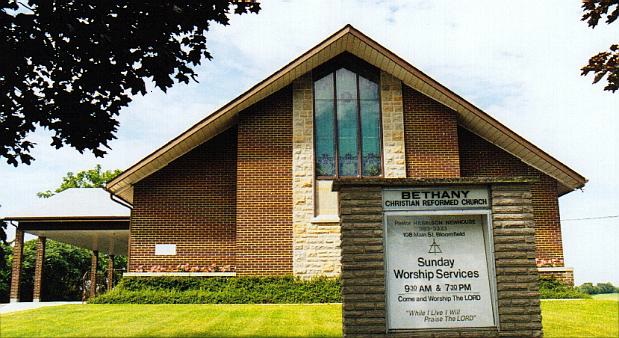
On March 17, 1962, Rev. J. Zantingh and John Hiddink laid the cornerstone inscribed with Ephesians 2:20 and Alpha/Omega symbols, and the completed building was dedicated on April 11, 1962, with greetings from local clergy, municipal leaders, and association representatives. Rev. Zantingh served until December 1964—initiating outlet park evangelism services while baptizing 50 children and receiving 22 professions of faith—and was succeeded by Rev. P. Breedveld from June 13, 1965, to September 1970, during which 25 members professed faith and 45 children were baptized. The late sixties featured successful vacation Bible schools, increased service participation including musical contributions from the CFB Kingston army band, and the unison recitation of the Lord’s Prayer and Apostles’ Creed, alongside discussions regarding the pace of transitioning services entirely into English for growing young families.
Mid-Century Growth and Language Transition in Our History
After Classis Eastern Canada divided in 1967 to form Classis Quinte comprising eleven congregations, the Bloomfield church experienced a vacancy overseen by counsellor Rev. Ringnalda and summer student John Visser, prior to the December 1971 installation of Rev. R. Praamsma, who oversaw the construction of a new parsonage on a lot purchased from Mr. M. Jackson after selling the old Picton residence. On March 27, 1974, a committee led by Mr. A. Ypma organized the 25th-anniversary celebration for 78 families, featuring guest speakers Rev. J. Betten, Rev. J. Zantingh, Mr. Robert Carter, and Mr. Phil Dodds, reflecting on 300 baptisms in the first quarter-century. Early seventies Sunday school adjustments—moving classes into the morning service on a temporary trial before returning to post-service schedules—preceded missionary support for Rev. DeBerdt in Japan and community-focused second services involving S.W.I.M. teams and inter-church vacation Bible school cooperation among Belleville, Bloomfield, and Trenton, supported heavily by Mrs. DeGroot and organized locally by Mr. Egbert Wemekamp.
Following Rev. Praamsma’s departure in 1976, seminary students Harry Bout and Jim Poelman successively filled summer vacancies, while an aging 1958 organ led to the October 1978 purchase of a $13,300 instrument from the Classical Organ Co., featuring donated bells from John Coenraads, an inaugural recital by regional organist Mr. Maddox, and a memorial plaque dedicated to fallen freedom fighters. In the summer of 1977, student Jim Poelman’s inability to preach in Dutch led elders to read translated sermons, culminating in a final official Dutch service on the second Sunday of September led by substitute reader Henry Nyman using a sermon by Rev. F. Guillaume. Although subsequent ministers like Rev. J. Kuipers did not preach in Dutch, they offered Dutch pastoral care, and the church later sponsored Vietnamese “boat people” refugee families including the Lams in 1979, while Mrs. L. Sneltjes succeeded Mr. E. Wemekamp as treasurer.
Community Outreach and Modern Expansion in Our History
Subsequent pastoral transitions brought Rev. P. DeVries following Rev. Kuipers’ move to Brampton, while broader practices evolved: park evangelism support questions arose, dual collections were streamlined by placing a subscription box at the back and keeping one service collection for kingdom causes, decorative displays were contributed by the Bock and Riemersma families, and elder family-visiting transitioned from pairs to single visitors. Communion frequency increased from four to six times yearly alongside an open invitation extended to all professing believers rather than restricted screening. In the fall of 1987, the Erwin property was acquired for $28,500 to expand parking, new fellowship groups like the Coffee Break Club, Men’s Life, and Men’s Breakfast emerged, organists shifted with Peter Buikema, Ann Kuipers, and Bill Prinzen playing after Lou Terpstra’s departure, and Joanne TenWolde and Dena Kamink assumed superintendent and treasurer roles respectively.
Although initial vision planning under Rev. P. DeVries was tabled, missionary support expanded to campus minister Dr. Bill VanGroningen at Queen’s University, and Rev. H. Salomons arrived from Ladner, B.C., in 1989 following Rev. DeVries’ move to Washington, subsequently leading a 1990 government-funded church extension project managed by contractor Elmer Terpstra to add meeting rooms and wheelchair accessibility. Following the organization of groups like the “Wine and Rose Club” and a supportive Music Guild, Rev. Salomons accepted a call to Lethbridge, Alberta, in 1996 after six years of service in Bloomfield, shortly after which Mrs. Salomons passed away, leading to the ordination of first-time pastor Rev. Harrison Newhouse. Looking back over fifty years encompassing over five hundred baptisms and numerous weddings, the congregation expressed deep gratitude for divine blessings and prayed that Bethany would continue serving as a welcoming home where the Lord meets His people.